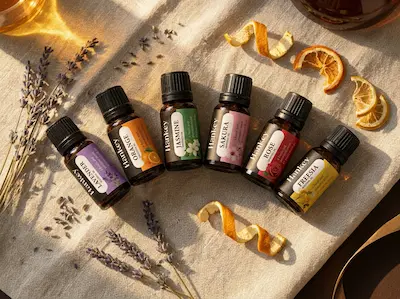
You don’t need a chemistry degree to build your own signature scent. You need three bottles and about ten minutes.
Blending your own oils can feel intimidating — like it’s a skill reserved for people with years of training. It isn’t. Once you understand the basic structure that perfumers and aromatherapists both use, you can start experimenting with confidence the same afternoon.
The Three-Note Structure
Almost every well-balanced blend follows a simple framework borrowed from perfumery: top, middle, and base notes.
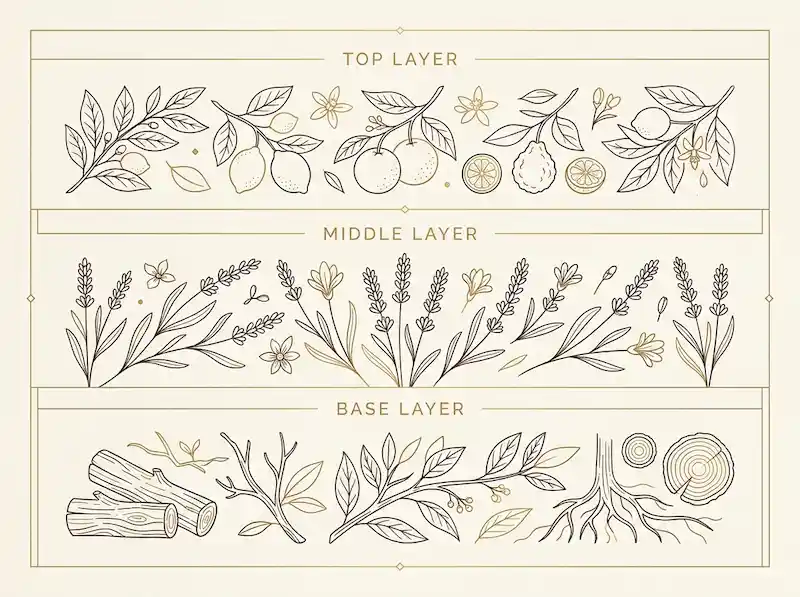
- Top notes are what you smell first — light, sharp, and fast to fade. Think citrus, mint, eucalyptus.
- Middle notes are the heart of the blend — they emerge a few minutes in and last longest in the air. Think lavender, rosemary, geranium.
- Base notes are deep and slow to release — they ground the blend and help the scent last. Think sandalwood, cedarwood, vetiver, patchouli.
A simple starting ratio: 3 parts top, 2 parts middle, 1 part base.
Three Beginner Blends to Try
1. The Calm-Down Blend
- 3 drops sweet orange (top)
- 2 drops lavender (middle)
- 1 drop cedarwood (base)
A gentle, well-rounded blend for evening wind-down. Almost impossible to get wrong.
2. The Clarity Blend
- 3 drops lemon (top)
- 2 drops rosemary (middle)
- 1 drop vetiver (base)
Brighter and sharper — a good companion for focused work sessions.
3. The Cozy Blend
- 3 drops bergamot (top)
- 2 drops geranium (middle)
- 1 drop sandalwood (base)
Warmer and a little more complex — often described as “the one that makes a house smell lived-in.”

Three Rules Worth Following
- Start small. Test any new blend in small batches — a few drops of each — before committing to a full diffuser reservoir. You can always add more; you can’t take oil back out.
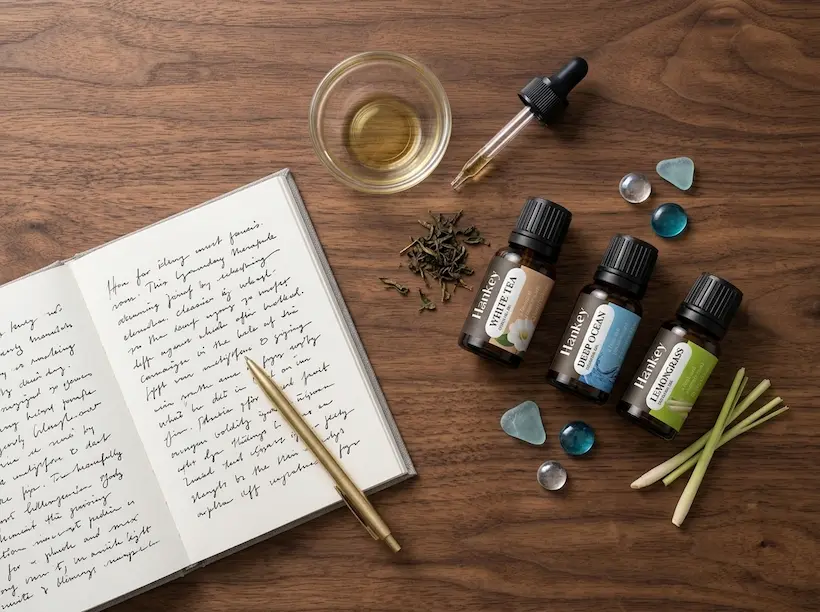
- Write it down. The blend you love on a Tuesday, you’ll want to remember on a Friday. Keep a simple note of ratios that worked.
- Let it rest. Some blends smell slightly different a few minutes after mixing than they do straight from the bottle. Give a new combination a minute before deciding you don’t like it.
What to Avoid as a Beginner
- Don’t blend more than 3–4 oils at once when you’re starting out. More isn’t more complex in a good way — it’s usually just muddy.
- Don’t skip the top note. A blend with only middle and base notes can smell flat or heavy with nothing to lift it.
- Don’t assume expensive means better in a blend. Some of the most-loved beginner combinations use the simplest, most affordable oils in a collection.

Ready to build your first blend? Our Discovery Set includes one oil from each of our six collections — enough to experiment with top, middle, and base notes without committing to a full range.