
Of all five senses, smell has the most direct route to the emotional brain. Here’s the neuroscience — and what it means for how you feel every day.
You walk into a room and smell something — pine, perhaps, or something warm and sweet — and before you’ve had time to identify what it is, you’re already feeling something. A memory surfaces. Your shoulders drop. Your mood shifts. It happened before you thought about it.
This is not coincidence. It is anatomy.


The Unique Architecture of Smell
Every one of your senses — sight, sound, touch, taste — sends signals to the brain via the thalamus, a relay station that processes sensory information before passing it on to higher brain regions. Smell is the only exception. Olfactory signals travel directly from the nose to the olfactory bulb, which sits in immediate anatomical contact with the amygdala and hippocampus — the brain’s emotional and memory centres.
This means that when you inhale an essential oil, its molecular information reaches your emotional brain before your rational brain has had time to evaluate it. You feel the response before you understand it. No other sense can do this.
This is why a particular scent can transport you instantly to a childhood memory with such vividness that you can almost feel the temperature of the day. It’s why the smell of coffee in the morning feels genuinely energising, not just anticipated. And it’s why aromatherapy — when used consistently and intentionally — can influence mood, stress levels, and cognitive performance in measurable ways.
What the Research Shows
The science of aromatherapy has moved well beyond anecdote. Here are some of the most compelling findings from peer-reviewed research:
Lavender and anxiety: Multiple randomised controlled trials have demonstrated that lavender inhalation significantly reduces anxiety — comparable in some studies to low-dose benzodiazepines, but without the side effects or dependency risk. A 2014 meta-analysis covering 15 studies concluded that lavender aromatherapy is an effective intervention for anxiety reduction.
Rosemary and cognitive performance: A study published in Therapeutic Advances in Psychopharmacology found that participants in a room diffused with rosemary essential oil performed significantly better on memory and speed tests than those in an unscented room. The effect was linked to measurable increases in the compound 1,8-cineole in participants’ blood.
Citrus and mood: Research conducted at the Mie University School of Medicine in Japan found that citrus fragrance significantly reduced the doses of antidepressants needed to normalise mood in depressed patients. Citrus oils were found to normalise neuroendocrine levels and improve immune function.
Peppermint and alertness: Studies at Wheeling Jesuit University found that peppermint scent increased alertness, reduced fatigue, and improved athletic performance — including reaction time and sustained attention.

The Concept of Scent Anchoring
One of the most practically useful concepts in scent neuroscience is what psychologists call “state-dependent memory” — the brain’s tendency to associate a specific sensory stimulus with the mental or emotional state present during repeated exposure.
In simple terms: if you consistently use a particular essential oil during meditation, your brain learns to associate that scent with the meditative state. Over time, simply inhaling that scent begins to trigger the associated state — even before you’ve sat down to meditate. The scent becomes an anchor, a neural shortcut to a desired state of mind.
This is why consistency matters in aromatherapy. The effects compound over time. The more regularly you use a specific oil for a specific purpose — sleep, focus, calm — the more quickly and reliably your brain responds to it.
Why This Matters for Daily Life
Most of us live in environments that assault our nervous systems continuously — screens, notifications, noise, the relentless pace of modern work. We spend very little time deliberately managing our internal states, and a great deal of time reacting to whatever state we happen to be in.
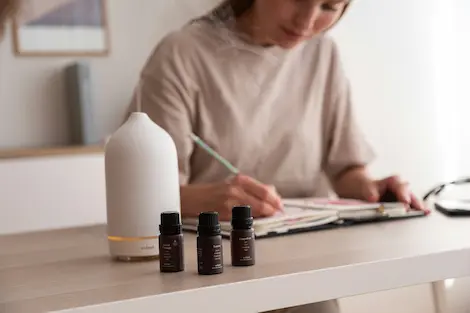
Aromatherapy offers a simple, accessible tool for state management. It doesn’t require meditation experience, special equipment, or significant time. It requires a diffuser, a few drops of oil, and the intention to use scent deliberately rather than accidentally.
Start with one oil for one purpose. Use it consistently for two weeks. Notice what changes. The science suggests you will.
A Note on Quality
The research cited above was conducted using pure essential oils — not synthetic fragrance oils. This distinction matters enormously. Synthetic fragrances can mimic the smell of essential oils but do not contain the same bioactive compounds. For therapeutic effect, always use 100% pure essential oils from reputable sources. Look for the botanical Latin name on the label, GC/MS testing documentation, and ideally organic certification.
Scent is one of the oldest tools for human wellbeing. The fact that neuroscience has now caught up to what ancient cultures knew intuitively makes it no less powerful — and arguably more accessible than ever.